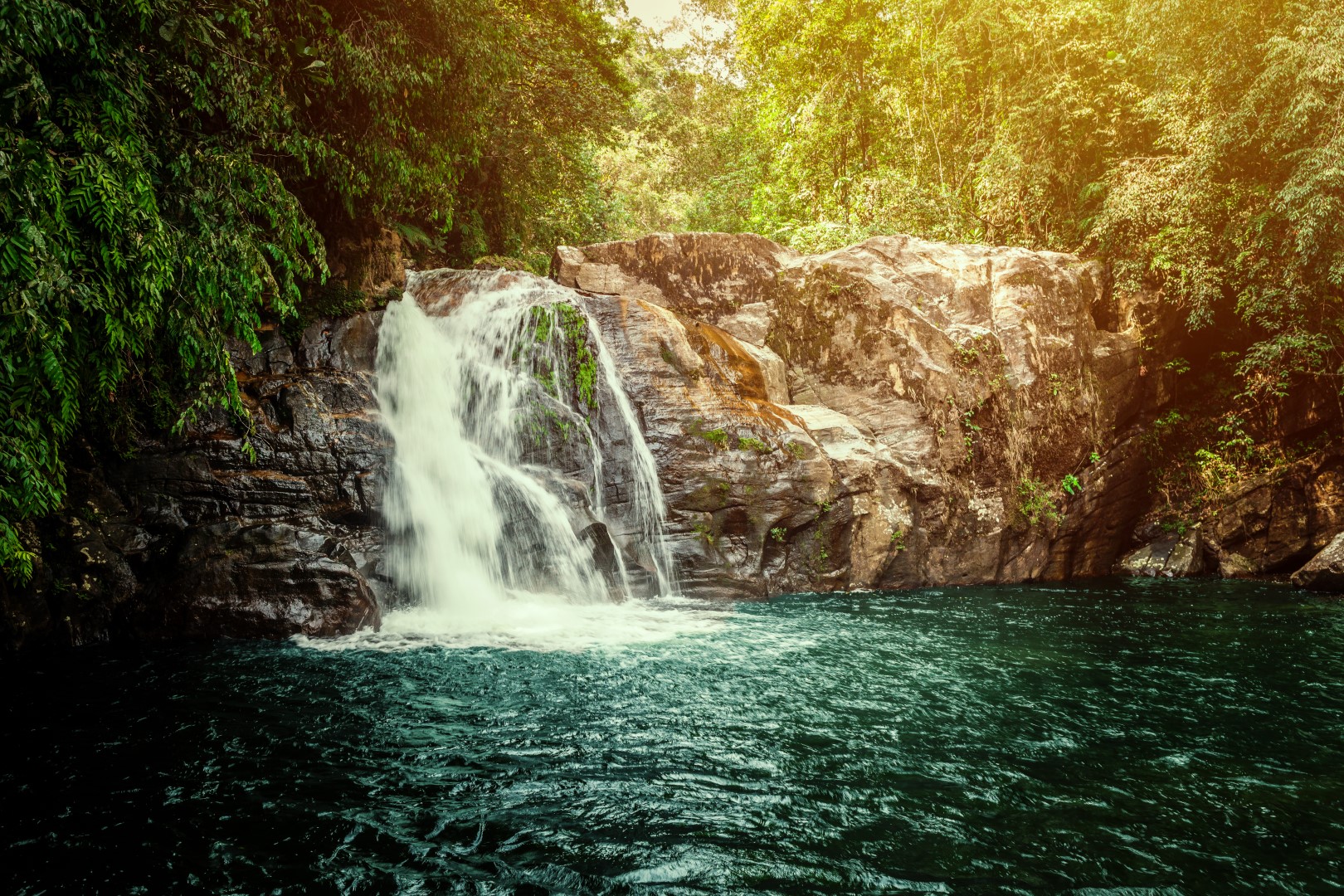
There are places in Sri Lanka that announce themselves immediately – the rock of Sigiriya visible from kilometres away, the white dome of Ruwanwelisaya rising from the flat plains. And then there is Sinharaja: a wall of green that reveals itself only when you are already inside it. The forest does not make promises from a distance. It simply receives you, closes behind you, and begins.
What Sinharaja Actually Is
Sinharaja Biosphere Reserve is the last substantial fragment of primary lowland tropical rainforest in Sri Lanka – 11,000 hectares of ancient, multi-layered forest in the wet zone of the island’s south-west. It is a UNESCO World Heritage Site, a Ramsar Wetland of International Importance, and one of the most biologically dense ecosystems in South Asia. Over 60 percent of Sri Lanka’s endemic woody plants are found within its boundaries. Of the island’s 26 endemic bird species, 21 occur in Sinharaja – a concentration found nowhere else on earth.
These numbers are significant. But what Sinharaja actually is cannot be adequately described by them.
The Walk
A Sinharaja walk begins at the forest edge – a boundary between the plantation world outside and the interior world within that is visible and audible even before you step across it. Inside, the light changes immediately: filtered, green, coming from above through a canopy so dense that direct sun rarely reaches the ground level. The humidity increases. The temperature drops slightly. The sounds that were background become foreground: the constant moving conversation of the forest.
The guide moves slowly. Slowly is the only way to do this correctly. A Sinharaja walk that covers distance is a Sinharaja walk that misses the point. The mixed-species flocks – groups of 20 to 40 birds of multiple species that move together through the forest in a cooperative feeding strategy – pass through on their own timing, and when they arrive the guide stops, points, whispers, and the next ten minutes become the most intensive birdwatching of most people’s lives. Sri Lanka blue magpie. Green-billed coucal. Red-faced malkoha. Ashy-headed laughingthrush. Species that exist in this forest and nowhere else, seen in numbers and at proximity that serious birders travel specifically to experience.
The Ecology of the Forest Floor
Sinharaja’s interest is not limited to the canopy. The forest floor and mid-story support communities of endemic lizards – including the green pit viper and several species of day gecko – and a remarkable diversity of endemic amphibians whose calls form the substrate of the forest soundscape. The soil is visibly alive: fungi of extraordinary variety, decomposer communities that process the fallen canopy into nutrients that feed the next generation of trees. A guide with genuine ecological knowledge turns this invisible activity into a visible, comprehensible system – the forest stops being a scenic backdrop and becomes a functioning organism.
Cinnamon, Streams, and the Human History of Sinharaja
The forest is not an untouched wilderness. Its human history is complex: ancient forest-dwelling communities, colonial-era logging that removed large areas before the reserve was gazetted, and the ongoing pressure of surrounding agricultural land. Wild cinnamon – Cinnamomum verum, the world’s finest quality cinnamon – grows throughout the forest, its distinctive bark visible on the smaller trees of the mid-story. Streams that originate in the Sinharaja watershed supply water to the surrounding communities; the forest’s role as a water catchment is one of the practical, economic arguments for its protection that complement the more abstract case for biodiversity conservation.
When to Go and How to Do It Properly
The best times for a Sinharaja visit are the inter-monsoon periods – February to April and August to September – when rainfall is lower and the forest is most accessible. But Sinharaja receives significant rainfall year-round (it is, after all, a rainforest), and the right clothing and attitude make any visit rewarding. The key variables are not weather but guide quality and visit timing. An early morning start – arriving at the forest edge by 6am – captures the most active bird period and the most atmospheric light. A specialist guide, rather than a general tour driver, transforms the experience from pleasant nature walk into genuine natural history encounter. Samen Reizen Lanka arranges Sinharaja visits exclusively with naturalist guides whose knowledge of the forest is deep and whose commitment to minimal-impact visitation is absolute.
What You Take Away
Most people who visit Sinharaja leave with something they did not expect: a sense of scale about what has already been lost. This is not a melancholy response – it is an informed one. Sinharaja is extraordinary precisely because what it represents – ancient, primary, biologically intact tropical forest – has been almost entirely eliminated from Sri Lanka and from most of the tropical world. Standing inside what remains, in the company of birds that exist nowhere else, in a forest whose complexity dwarfs anything the surrounding landscape can show, is a privilege that makes the preservation case not in abstract but in immediate, visceral terms. This is worth protecting. Obviously. Evidently. And the experience of being here is the best argument for ensuring that it is.