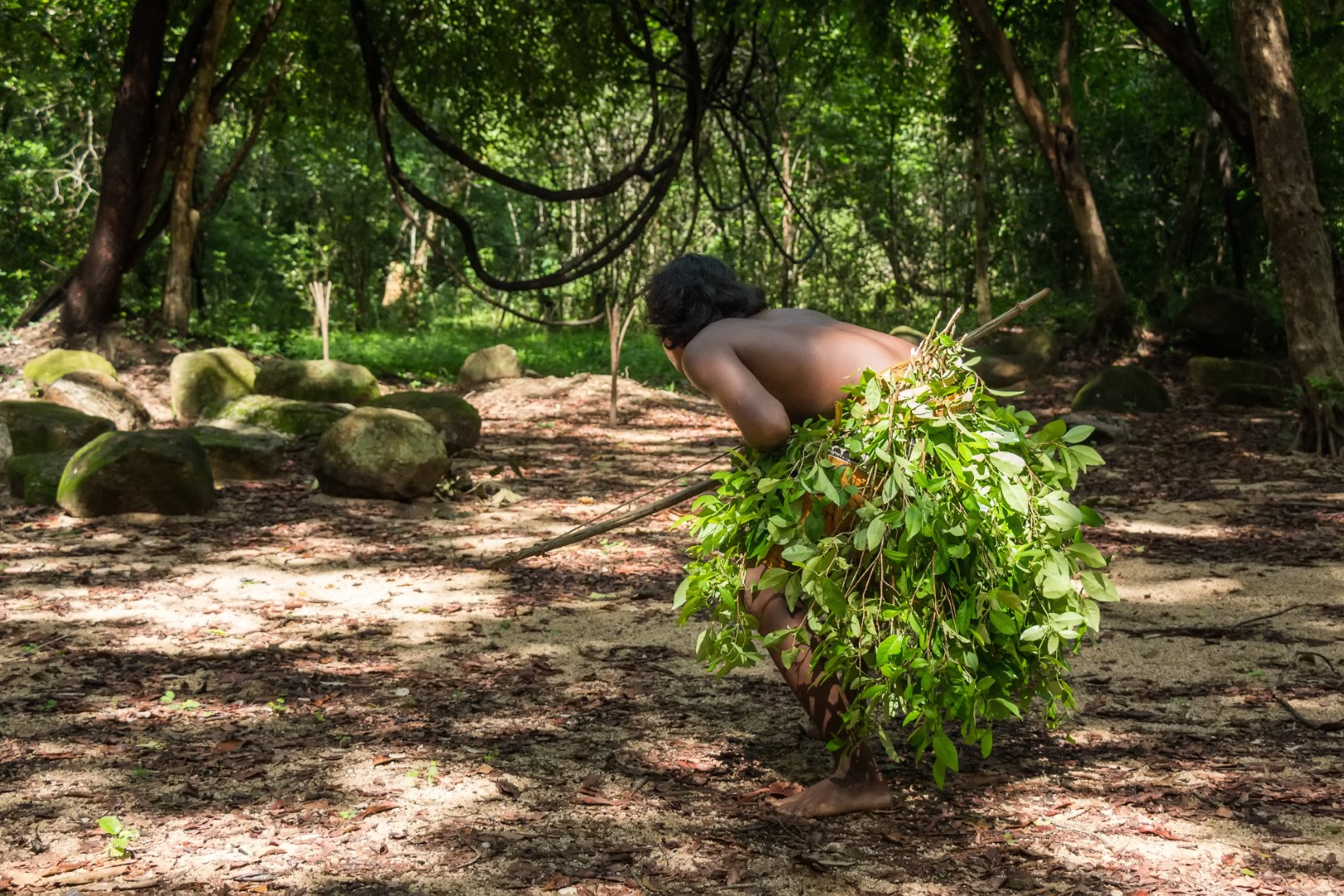
Every country has communities whose history predates the dominant narrative. In Sri Lanka – a nation whose recorded history extends back over 2,500 years – it is the Vedda people who occupy this position: an indigenous community whose presence on the island predates the Sinhalese civilisation that surrounds them, and whose forest-based way of life represents one of the oldest continuous human cultures in South Asia. They are not a museum exhibit. They are a living community with opinions about the present and concerns about the future. And encountering them, done properly, is one of the most genuinely meaningful things a traveller can do in Sri Lanka.
Who the Vedda Are
The Vedda (also spelled Veddah or Wanniyalaeto – ‘forest dwellers’ in their own language) are Sri Lanka’s oldest known inhabitants, descended from pre-agricultural communities who lived across the island before the arrival of the Sinhalese and Tamil populations that now make up the majority. Archaeological evidence links them to the Balangoda Man – a prehistoric human population whose remains have been found in cave sites across Sri Lanka dating back 38,000 years.
Today, the Vedda number a few thousand – a community diminished by displacement, cultural assimilation, and the loss of the forest territories that sustained their traditional way of life. The communities that maintain the most direct connection to traditional Vedda culture are found in the Dambana area near Mahiyanganaya in the island’s interior – a region of dry zone forest that still provides the ecological context in which Vedda knowledge and practice make sense.
What the Traditional Vedda Life Looked Like
Vedda culture was structured entirely around the forest. Hunting – using bows and arrows with extraordinary skill and ecological knowledge – provided protein; honey collection from the hives of wild rock bees provided sweetness and ceremony; yams, roots, and wild fruit completed the diet. The Vedda maintained a detailed knowledge of the forest’s ecology – the movement patterns of animals, the seasonal availability of food sources, the medicinal properties of specific plants – that accumulated over thousands of years of intimate dependence on the same landscape.
Their social structure was organised around small family groups with collective decision-making. Their cosmology centred on ancestral spirits (nae yakku) inhabiting the forest, whose presence was invoked through ritual and whose guidance governed important decisions. The arrowhead and the bow were not merely tools – they were sacred objects with ritual significance embedded in ceremony.
The Encounter
A visit to a Vedda community through Samen Reizen Lanka is arranged in genuine partnership with the community itself. We work with community leaders in Dambana to ensure that visits are conducted on the community’s own terms – that what is shared reflects what the community wishes to share, that the benefit of tourism flows directly to the families who host it, and that the experience is educational rather than voyeuristic.
What a visit typically involves: an introduction to traditional hunting tools and the techniques of Vedda archery, demonstrated by community members who carry this skill as living knowledge rather than staged performance. A guided explanation of the forest ecology from a Vedda perspective – a way of reading the landscape that is qualitatively different from the naturalist’s botanical and zoological framework, grounded instead in thousands of years of practical dependence. And a shared meal experience – simple food, prepared in the way that has sustained this community across generations.
The Contemporary Reality
The Vedda’s relationship with the modern Sri Lankan state has been complicated. The establishment of national parks and reserves in the areas that were Vedda traditional territory displaced communities from lands they had inhabited for millennia. The cultural assimilation pressures that accompany integration into a majority society – schooling, employment, migration to urban areas – have reduced the number of families maintaining traditional Vedda cultural practices to a small core.
The community leaders in Dambana are acutely aware of this situation and hold considered views about what it means to maintain cultural identity in the contemporary world. They are not isolated – they have smartphones, they interact with government authorities, they have opinions about tourism. A conversation with community leadership about these questions, mediated by a guide with genuine relationships in the community, is a significantly more interesting and honest encounter than a visit structured around romanticised performance.
Why This Matters to a Traveller
The Vedda encounter matters for travellers because it asks a question that all responsible tourism asks, but rarely makes explicit: what does it mean to visit a community, and what does that visit do? A Vedda visit done thoughtlessly – treated as an attraction, photographed for content, exited after 45 minutes without genuine engagement – contributes to a dynamic of commodification that is damaging to communities and dishonest to travellers. A Vedda visit done well – with time, with genuine curiosity, with economic benefit flowing directly to the hosts, and with the understanding that this is not a performance but an introduction – is something else entirely.
It is, in the most direct possible terms, a reminder that Sri Lanka’s human history is deeper and more complex than the monuments and the beaches suggest. The Vedda are not a footnote to that history. They are its opening chapter, still being written.